12 January, 2002

Still brilliant sales

I am sorry (no, not really). It is almost trivial to repeat it. But, here goes, the sales of champagne in 2006 seem - even before it has been finally added up -to have beaten all imaginable records. Once again.

Before October was all over a number of 320 million bottles was already sold. And since the sales of champagne normally peaks in the last quarter of the year - shopping for the parties of Christmas and New Year's Eve puts it's heavy finger prints in the sales statistics - it is expected that 2006 must finally beat the record of the Millenium.

The sales back in 1999 reached the exorbitant heights of 327 million bottles. Quite a few of them however were bought to stock, which made the sales decline remarkably the following year.

England and Spain
Just about one out of two bottles of champagne is drunk in France. It used to be six out of ten bottles. The growth of sales is thus due to export. The development is in other EU-countries, the States and the exotic hopes for the future such as India and China.

In 2006 the English and the Spanish have bought plentiful amounts of champagne.

British Sainsbury's talks about a progress of 3.000 percent in the sales of the supermarket's own label, says Decanter.com. Probably helped by several blind tastings that this autumn gave really good notes to several of the British supermarket champagnes.

In Spain the sales from July 2005 to July 2006 has grown 40 percent according to La Journée Vinicole. Not bad in a country with its own big production of cava. The Spanish market with three million bottles remains at only one tenth of the British.

Possible pressure of stocks
Yves Benard, who is chairman of the organisation, that represents houses such as Veuve Clicquot, Boizel-Chanoine and Vranken-Pommery Monopole, foresees more growth in 2007 yet in a more moderate tempo, writes the British newsagency Reuters.

He points to the fact, that stocks may be put under pressure. This is what is feared more than anything: That you cannot cope with demand with unwanted increases of prices and followed by the risk of decrease as the result.

The final numbers of the sales of 2006 are expected in February.

På dansk

Copyright: The copyright for text and photos at bobler.blogspot.com belongs to Solveig Tange. You may use my articles, photos or parts of them for non-commercial use and if I am credited as the author. Feel free to link to this site but not in your own frameset please.

11 January, 2002

Second buds

 
Chardonnay, Loisy-en-Brie, January 7th 2007.
Posted by Picasa

This is the gold of Champagne. These buds are what it is all about. They were created in the last cycle of growth, and are thus fertile this year.

The top picture shows Chardonnay-buds. They often unfold earlier than the two red grape varities.

The picture below shows Meunier-buds. Several are double, and that is characteristic. This type of vine produces more double buds than Chardonnay and Pinot Noir.

This means, that if you have a plot with a particular risk of frost, you can plant it with Meunier, and hope that the second buds will help you to achieve your authorized yield, in years where frost burn the first buds.

In 2003 we actually did do a second harvest in our Meunier-vines. Still, even with double buds there are not at all the same amount of mature grapes from the second group of buds as from the first one. But that particular year it was still worth doing a second grapeharvest in October.

 
Meunier, Loisy-en-Brie, January 7th 2007.
Posted by Picasa

So far the temperatures has had more in common with spring than with winter. As in Denmark we see the bulbous plants of spring peep out from the soils. And roses and geranium still bloom.

But, but, but... We have seen nothing from the winter of 2007 yet, says our neighbour. So I will leave my skiunderwear and wollen socks within easy reach for the time being.

På dansk

Copyright: The copyright for text and photos at bobler.blogspot.com belongs to Solveig Tange. You may use my articles, photos or parts of them for non-commercial use and if I am credited as the author. Feel free to link to this site but not in your own frameset please.

Smash the bubbly

The war about champagne continues. New means allowed and this must be the first time the destructions of false bubbly is available on video . What a scoop! Should be spreading round the web like virus and ads for viagra. Whether it will stop people from buying American champagne is more doubtfull, isn't it?

The war is a war. One one side the winegrowers of Champagne and their white collar officials, who say that true champagne is only produced in the French region with the same name. On the other side, you find several American producers of sparklers. They claim, that champagne is just a sparkler and it can originate from everywhere where sparkling wines are produced. Such as California.

And the sunny westcoast state was the point of origin for 3.288 bottles of bubbly with destination Nigeria, Africa. Unfortunately for André Champagne Cellars Belgian customs found the bottles before, and in Belgium - in fact all over the EU - the bottles were illegal. Since within the EU you are not allowed to use geografical designations for your product, unless it actually originates from the appropriate region.

Fight for decades
The fight about the right to use the word champagne is an old one. The view of the EU is, that words like champagne, porto and Stilton cheese designate products from certain regions. Therefore they cannot be applied for products, that has been produced elsewhere. In the US the view is, that these words rather designate certain types of products. For instance champagne is a sparkling wine. The difference in definition has been discussed for decades in international trade organisations like GATT and at the moment the WTO.

And the discussions continue. The latest deal from spring 2006 ensured, that only American producers, that all along have sold their wines as champagne, can continue. But not in countries that acknowledges the geographical designations, not even as transit, as the example from Belgium clearly demonstrates.

At a press conference yesterday Bruno Paillard, one of the CIVC-presidents, said, that the customs all over Europe has destroyed more than 14.000 bottles of illegal champagne from countries like Argentina, Russia and Armenia, since the rules came into force. The CIVC is the common organisation of champagne houses and winegrowers. Amongst many duties it works with the defense of the appellation, that is the name of champagne.

09 January, 2002

Super position

 
Pruned Meunier-plants in Loisy-en-Brie.
Posted by Picasa

Our pruning has finally begun. Alain has found a guy in Vertus, who is now doing some of the job.

With his girlfriend he has pruned the first Meunier-vines following the 3-9-6 system.

  • Three buds on the little stump le rachet in the bottom.
  • Nine buds on the young hope la baguette.
  • Six buds on the one year old extension of the old one le prolongement.

    And that would be the end of it if not monsieur or maybe madame leave the vines with superposition.

    Superpositioning
    If you translate to Danish or English the wrong way superpositioning sounds great. But we do not really like the phenomenon, since it is strictly forbidden in the AOC-laws. Which is also why it is the fast and easy way to fail your exam in pruning.

     
    When you attach the two bows, one young wood will be placed above the other. This is superposition, and we do not like it.
    Posted by Picasa

    Diligent readers of this blog may remember to have heard the word a few times before. I have written about it rather thoroughly, since it was part of my method to learn how to avoid it.

    The problem is buds, that lye on top of each other. When you prune for instance Meunier followong the 3-9-6-method - the Vallée de la Marne that is - you will eventually bind two bows at the fence. One on top of the other. It is important that the buds of the young bow end before the buds on the young part of the old bow start. In this way you avoid that the branches, that will grow from the buds in the spring, will disturb each other.

    To prioritate right
    To avoid this you need to abandon the principle of 3-9-6 a bit and instead leave only the possible amount of buds. A question about the right prioritation really. No superposition is more important than the correct amount of buds. And this our friend does not follow.

    He failed his exam anyway. But then, so did many others, and not all of them very justified, it seemed. So for me failing the exam does not necessarily mean that you do not know how to prune. You just need to be told, I guess.

     
    Our local machine pool has delived wooden chops between the rows, and that makes it a lot easier to work in the wet winterseason.
    Posted by Picasa

    We plan to begin pruning the other plot with the cordons next weekend.

    På dansk

    Copyright: The copyright for text and photos at bobler.blogspot.com belongs to Solveig Tange. You may use my articles, photos or parts of them for non-commercial use and if I am credited as the author. Feel free to link to this site but not in your own frameset please.

  • 08 January, 2002

    Islands celebrated euro with champagne

    The Mediterranean island-states of Malta and Cyprus have joined the euro. The island bigwigs said hello and goodbye with champagne in their glasses. I could be tempted to say: What else?

    Cypriots and Malteses can prepare themselves for daily brain gymnastics. The psychological crossing from one currency to another is rather immense, when the calculations are not just the purchases of two weeks of holidays somewhere but instead cover your complete life with everything from toothpaste to flatscreens.

    Seven years after the euro succeeded the French franc, many shops still put their prices in francs. And personally I still - after four years in France - convert from euroes to the Danish currency "kroner" and "oerer". Otherwise I just don't get the prices right.

    When it comes to the price of the very official toast of Malta and Cyprus, I don't know whether the big champagnehouses sponsor this type of events. If not, they should. Since it cultivates the image of champagne in the most guilded way, you could possibly want, if you happen to be in the field of marketing champagnes.

    Taittinger is back

    Members of the Taittinger-family have bought 37 percent of the shares in the champagnehouse with their name.

    The head of the family, Pierre-Emmanuel Taittinger, says that he still looks for "friendly capital" for the last 43 percent of the shares, reports French media.

    So what is "friendly capital"? My bid - after some years of reading about the unfortunate tries of several international giants to buy their way into French heritage is - as a minimum - that seller sympathizes with the intention of the buyer, the actual as much as the presumed.

    The annual production of Taittinger is 4,5 million bottles of champagne, which is enough to be number seven amongst the big producers. Amongst the most mentioned and praised assets of the house are their 290 hectares of vines in the best areas.

    07 January, 2002

    Sharp new year

     
    Posted by Picasa

    2007 promises rather keen in Verzy.

    In the middle of last December the nice, old man with the big white beard skipped a champagne sabre over the edge of his sledge as he rushed over the Montagne de Reims... No injuries. The weapon was properly packed up.

    I think this idea of the old man was rather inventive. And certainly unexpected.

    Wine in the streets
    Our local - and regional - party of the wine, the Saint Vincent, is coming up soon.

    Alain and I will be presented with our diplomas, now officially capable of pruning the vines. The local guild will unfortunately do the party on a monday, which for us will mean a modest participation of claqueurs, most are working.

    While we wait for free wine in the streets on January 22nd, we enjoy the sales of more than 320 million bottles already by the end of October. It seems likely that the total of the year may even pass the 327 million necks of the Millenium.

    Our new year
    It will be time to start the re-establishment of our new, sadly mistreated plot. For a start, prune it in a way, that approaches the theory books.

    We will also have to work with the idea of obtaining our own champagne brand in a more concrete way. The bigger amount of grapes, we can harvest this year, will bring more income, which makes it more realistic to begin thinking about a life with champagne full time.


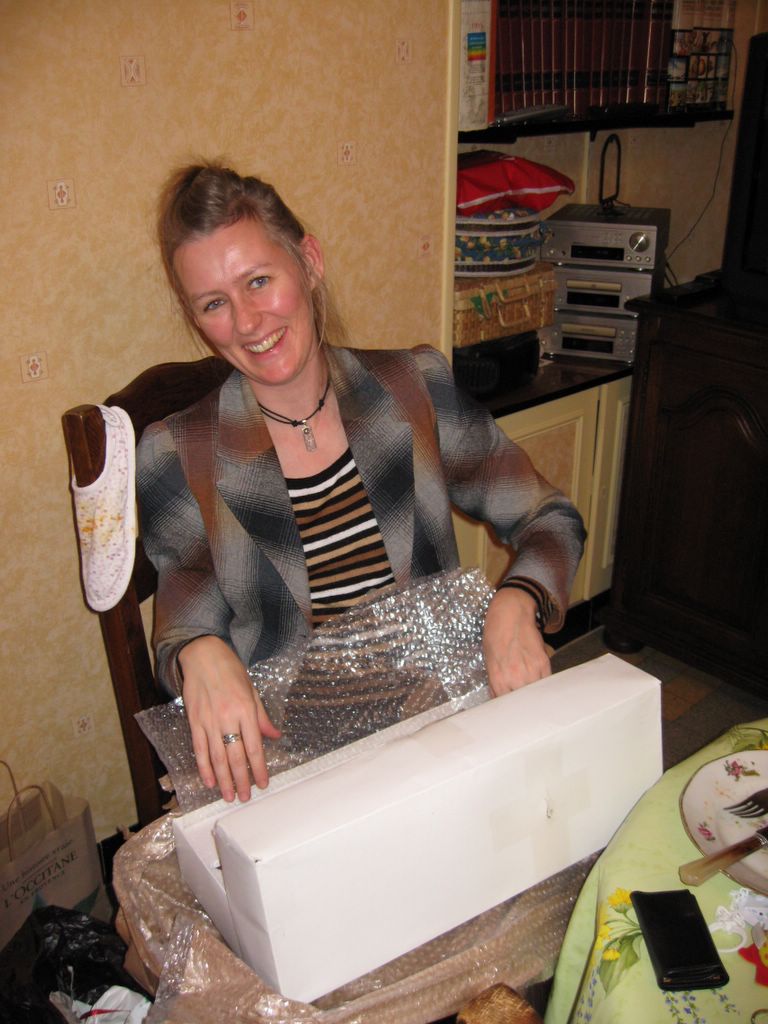
    For she who owns everything (almost): Own sabre!

    The new ownership of my own weapon has displayed another difference between my current and the former country of residence. In France it is a right to possess this kind of thing... I Denmark you need a permission from the police to keep swords, sabres and similar effects in your private home. This I know from the little sister who technically does not possess her own weapon, since ice axes don't count. The other little sister has her own sword, thus police permission to keep it.

    Happy New Year.

    På dansk

    Copyright: The copyright for text and photos at bobler.blogspot.com belongs to Solveig Tange. You may use my articles, photos or parts of them for non-commercial use and if I am credited as the author. Feel free to link to this site but not in your own frameset please.

    12 December, 2001

    Meet the Yellow widow in Illum

    More than 12 years ago I saw my first champagnebar. It is situated in Reims, just across the street from the big, central Place d'Erlon, and it is not excactly high tech. Actually it reminds me more of the kind of little more or less stationary chariots where you buy your hotdogs in Copenhagen. Just a little bit more Art Déco chic since this after all is France. Anyway, it is not sausages but champagne à la coupe, they hand over the counter.

    There are lightyears between this and the ultratrendy space, that Copenhagen department store Illum has introduced to fit the galloping Danish consumption and the luxury trend of the time. However only in December. Danes still mainly drink champagne in the Christmas- and New Year's-season as it is anyway quite general all over the world.

    It is the French behemoth of luxuries LVMH (Louis Vuitton Moët Hennessy), who is behind the initiative. Which is why you can only buy the champagnes of LVMH, and only some of them. Names as Ruinart and Krug, that also belong to this economical giant of the champagne, are not available.

    The classic Yellow Widow, as the Veuve Clicquot-Ponsardin is popularly known in Denmark, is not difficult to find in December. It is still the sure and often also lonely brand, you will find if you buy your wines in supermarkets such as Foetex and Kvickly in the days before Christmas. So this is just another possibility of trying the lady, even a lot of Danes do not even like the taste. In Illum they can try out the Moët & Chandon instead or even upgrade to a Dom Pérignon. Prices per glass according to AOK begin at 75 kroner(10 euros).

    På dansk

    Copyright: The copyright for text and photos at bobler.blogspot.com belongs to Solveig Tange. You may use my articles, photos or parts of them for non-commercial use and if I am credited as the author. Feel free to link to this site but not in your own frameset please.

    11 December, 2001

    Champagne the granny way

    The appellation champagne is defended tooth and nail by the lawyers of the organisation of the champagne industry, the CIVC. It is easy to understand - for me anyway - that they do not want to share name and glory with sparkling wines from other parts of the world. It is more complicated for my mind to follow for instance their wish to eliminate champagne as the name of a colour.

    I should like to know how these interpreters of clauses would react to this charming application of one of the inhabitants of a true Granny's garden.

    "If you want to prepare Champagne, you will only have to add two teaspoons of this must and mix it with a bottle of French wine, bottle it and shake it well". (My translation).

    The mentioned juice is made of white currant. A berry, I mainly know from old gardens, especially in the white version. Some people think, that champagne is sour dishwater. I wonder if that could be an effect caused by the juice of the currant?

    The recipe originates from the "Handbook of the Housewife", 1903. You will find the entire recipe here (is it not typical that it will be in a Norwegian webpage that a thing so inadmissible will turn up?) ;-D

    På dansk

    Copyright: The copyright for text and photos at bobler.blogspot.com belongs to Solveig Tange. You may use my articles, photos or parts of them for non-commercial use and if I am credited as the author. Feel free to link to this site but not in your own frameset please.

    09 December, 2001

    Esca up in smoke


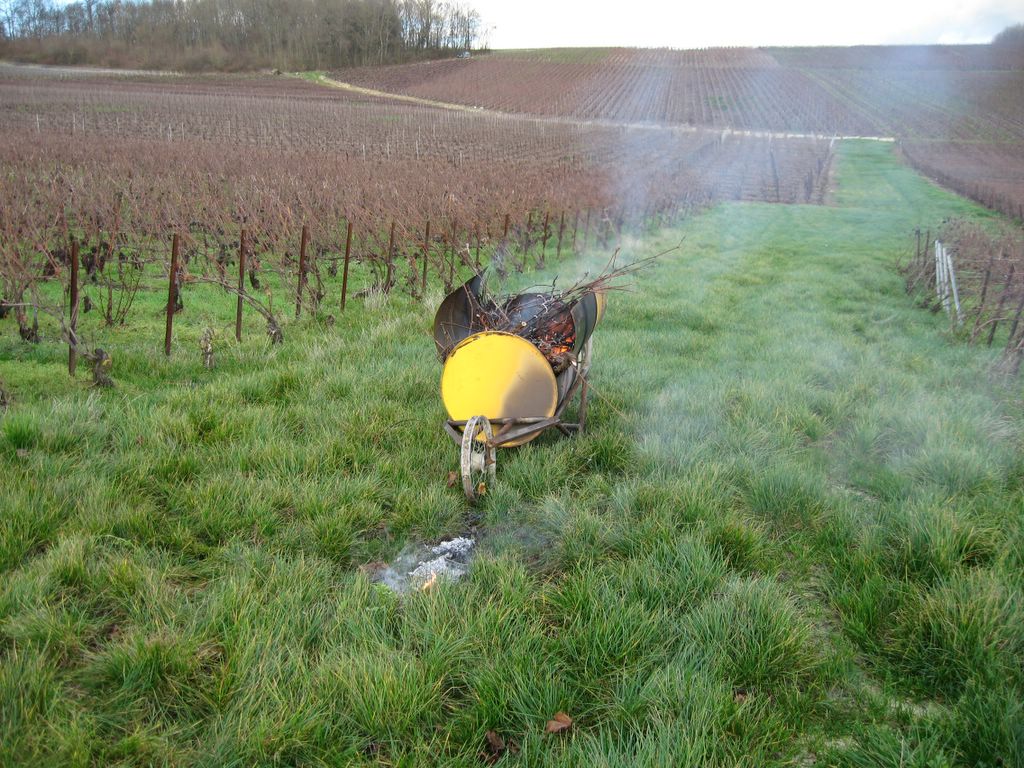
    Cut branches burn in the brouette, Loisy-en-Brie.

    The day after the tornado is quiet and beautiful. Decembersunny and made in heaven to go work in the vines.

    Alain spends most of the light hours of saturday in Loisy-en-Brie in the very extreme end of the Côte des Blancs to get rid of Esca-infested Meunier-vines in our two plots.

    It is some weeks ago now, that he spent some hours spraying the diseased plants with red colour. Today it would have been impossible to distinguish diseased plants from healthy ones. Once grapes are gone and leaves fallen, the naked branches look quite alike no matter their condition.

    Alain removes all branches so that only the stump remains. The entire root is a different story that cannot be removed without the intervention of a lot more horsepower, so for the time being they are left where they are.


    Red alert: An Esca-diseased plant to be removed.

    The two plots all together make up a bit more than one hectare. In one day Alain removes almost 70 percent of the diseased plants. There are a lot more in the new plot, that we have received back in a rather poor condition.

    We would have preferred to see no more Esca in the old plot, since we used quite some time last year to remove diseased plants with roots and this year to replant more than 400 replacements.

    But this is not how it all went, and it is a destiny we share with a lot of others that inside and outside Champagne fight this infectious disease as well. It is spreading rapidly these years because of the warmer weather and because the chemical to fight it has been forbidden in some years now.

    På dansk

    Copyright: The copyright for text and photos at bobler.blogspot.com belongs to Solveig Tange. You may use my articles, photos or parts of them for non-commercial use and if I am credited as the author. Feel free to link to this site but not in your own frameset please.